Why Learn from Lovejoy? An Artist and Teacher for First-Time Painters
If you are thinking about taking a Paint Your Pet class—or any beginner-friendly painting workshop with me—it makes sense that you would want to know a little about the person teaching you.
There are a lot of art classes out there, and they are not all designed the same way.
Some are mostly social events with very little instruction. Others move quickly or assume that everyone already understands the basics. And some are taught in a way that can leave a first-time painter feeling lost, intimidated, or unsure of what to do next.
That has never been my goal.
I started teaching because I wanted painting to feel approachable, meaningful, and enjoyable for real people—especially beginners and people who have never painted before.
I want you to feel welcomed when you arrive, supported while you are painting, and genuinely proud of what you created when you leave.
And yes, I am a big Bob Ross fan. I have always appreciated the way he helped people believe they could paint. That idea—that creativity should feel encouraging rather than intimidating—is a big part of how I teach too.
More Than 15 Years of Teaching Beginners
I have been teaching beginner-friendly painting workshops for more than 15 years.
During that time, I have worked with all kinds of students.
Some arrive excited and ready to begin. Some are visibly nervous. Some tell me they have not held a paintbrush since elementary school. And many walk in saying some version of, “I’m not artistic,” or, “I’m probably going to be terrible at this.”
But after teaching for this long, I have learned something important:
Most people are far more capable than they think they are.
They simply need the right environment, clear guidance, and enough encouragement to keep going when the painting is still in its awkward middle stage.
Because every painting has an awkward middle stage.
Experience has taught me where beginners commonly get stuck, what tends to overwhelm them, and what kind of explanation helps something finally click.
I know when to slow down, when to demonstrate something again, and when a student simply needs reassurance that they are doing better than they realize.
I Teach Beginners—Not Just People Who Already Feel Artistic
My classes are intentionally designed for first-time painters and beginners.
I do not teach as though everyone already understands color mixing, brush control, shading, or how to build a painting in layers.
I explain the process.
I pay attention to pacing, clarity, and the energy in the room. I want people to feel comfortable asking questions without worrying that they are behind or that they should already know the answer.
You do not need to arrive with confidence.
You do not need to know how to draw.
You do not need to be “good at art.”
You just need to be willing to show up, follow the process, and try.
That is enough.
Confidence usually does not come before we begin something new. It grows because we begin, stay with it, and discover that we are capable of more than we expected.
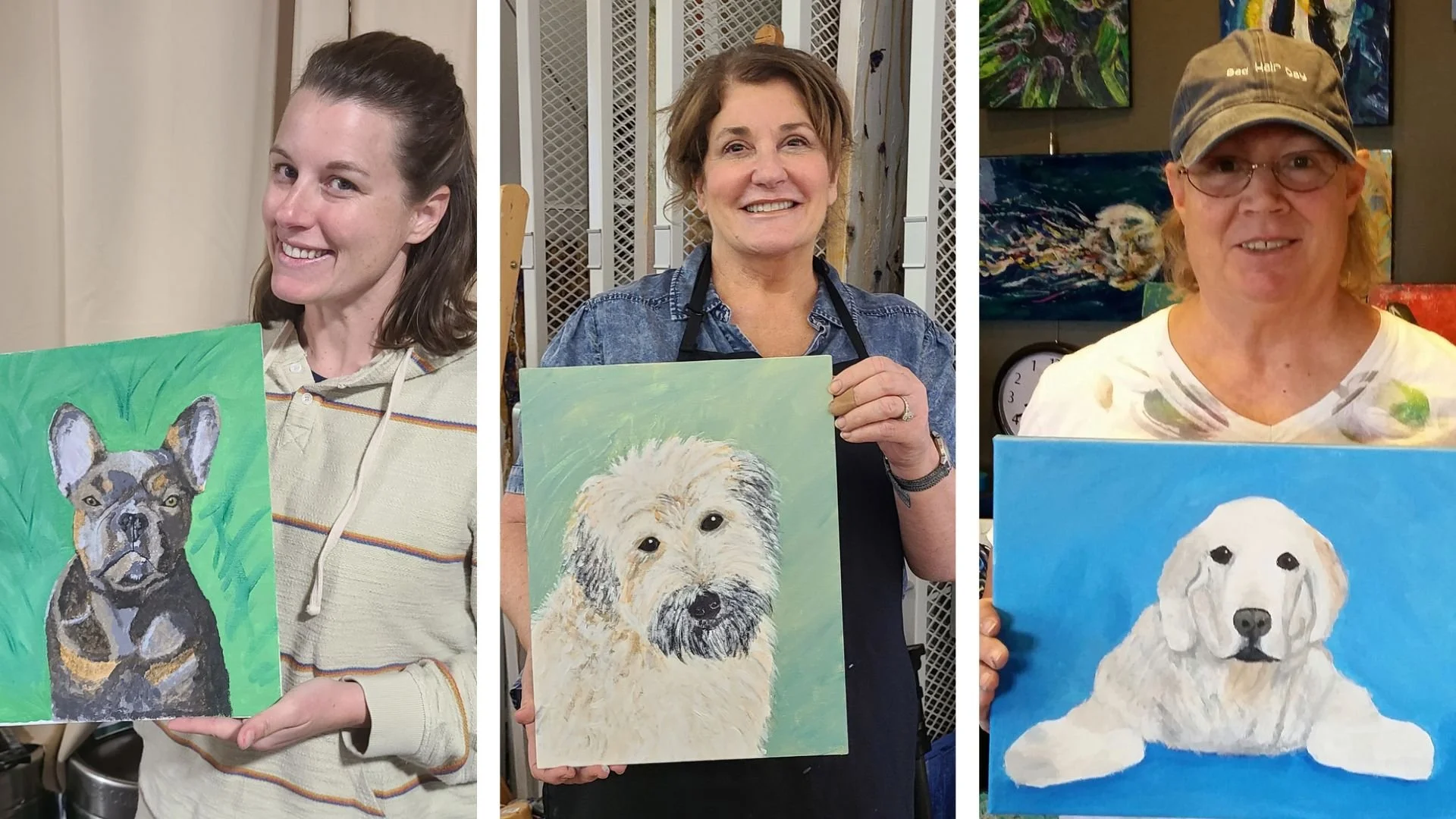
Painting Something You Already Love
Paint Your Pet is especially meaningful because you are not painting a random subject.
You are painting an animal you love.
You already know that face, that expression, and that personality. You know the way your dog looks when they are waiting for a treat or the particular expression your cat makes when they are judging everyone in the room.
That emotional connection changes the experience.
You are not simply practicing brushstrokes or filling in shapes. You are creating something personal—something connected to a relationship, a memory, and a part of your life that matters to you.
That gives the creative process more heart.
It also gives you a reason to stay engaged when the painting becomes challenging. You care about the subject, so you are willing to keep working, adjusting, and trusting the process.
That is one of the reasons I love teaching Paint Your Pet workshops. They bring together creativity, learning, emotion, and connection.
You are not only making a painting.
You are creating a portrait of someone you love.
Clear, Step-by-Step Guidance
A good teacher does more than stand at the front of the room and demonstrate.
A good teacher helps you understand what to do next.
When beginners feel overwhelmed, it is often because they are trying to think about the entire painting at once. They are looking at the eyes, the fur, the background, the proportions, and the final result—and suddenly it all feels like too much.
So I break the painting process into manageable steps.
We work in layers.
We simplify complicated shapes.
We focus on one decision at a time and gradually build the painting from the background and larger areas into the smaller details that bring your pet’s personality to life.
You do not have to hold the entire process in your head.
You only have to focus on the step we are working on right now.
That helps students stay grounded and enjoy the experience instead of worrying about whether they are doing everything perfectly.

I Help Without Taking Over
This part of teaching matters to me a great deal.
I want you to feel supported, but I do not want you to leave feeling as though someone else painted your picture for you.
I do not take over your canvas.
When you need help, I use my words, point out what I am seeing, and demonstrate techniques on the table covering so you can watch the movement and then try it yourself.
My role is to guide you, teach you, encourage you, and help you understand what you might adjust.
But the painting should still feel like yours.
That is why students often feel so proud at the end of class.
They know they created it.
Yes, they had guidance. Yes, they may have needed reassurance or help solving a problem along the way. But they made the choices, held the brush, mixed the colors, and brought the painting to life.
That sense of ownership builds confidence.
And sometimes it changes the way a person thinks about themselves.
They came in believing they could not paint, and a few hours later, they are holding proof that they could.
A Relaxed and Welcoming Atmosphere
Not everyone wants a class that feels loud, rushed, crowded, or performative.
Many people who come to my workshops are looking for something more personal and grounded.
They want to enjoy being creative without feeling judged. They want clear instruction, but they also want room to settle in, focus, and enjoy making something with their hands.
That is the atmosphere I work to create.
I want the class to feel warm, supportive, and relaxed.
You are allowed to ask questions.
You are allowed to take a moment and look at your painting.
You are allowed to make changes.
And you are allowed to be a beginner.
There is no pressure to perform or prove anything.
For many students, that becomes an important part of the experience. They are not just learning how to paint. They are stepping away from their usual responsibilities for a few hours, concentrating on one meaningful project, and giving themselves permission to be creative.
The Experience Matters as Much as the Painting
Of course, I want you to leave with a painting you love.
But I also care deeply about how you felt while you were making it.
Did you feel welcomed when you arrived?
Did the instructions make sense?
Did you feel comfortable asking for help?
Did you feel encouraged when you reached a difficult part?
Did you leave feeling more capable than you did when you began?
Those questions matter to me just as much as the finished canvas.
A successful class is not only about producing a technically perfect painting.
It is about creating a positive, memorable, confidence-building experience.
You may hang your painting on the wall, give it as a gift, or look at it years from now and remember the pet you loved.
But I also hope you remember the moment when you stepped back, looked at what you had created, and realized, “I actually did this.”
Being an Artist and Being a Teacher Are Different Skills
Being a talented artist does not automatically make someone a good teacher.
Teaching requires patience, clarity, observation, adaptability, and the ability to meet people where they are.
A teacher needs to understand that different people process information in different ways. Sometimes one person needs to see a demonstration. Another needs a verbal explanation. Someone else may need the process broken into a smaller, more manageable step.
Those teaching skills have developed through years of working directly with students.
I watch closely.
I listen to the questions people ask.
I notice when someone is becoming frustrated, when they are overthinking, or when they are much closer to solving the problem than they realize.
I want students to feel that they are in experienced hands, especially when they are doing something unfamiliar or stepping outside their comfort zone.
Every Painting Is Personal
My classes are not about producing a room full of identical paintings.
Every pet is different.
Every face, expression, coat pattern, and personality is different. Even when students are learning the same techniques, each painting develops its own character.
That means the instruction needs to be personal too.
I pay attention to what each student is working on and where they need support. One person may need help adjusting an eye. Another may be trying to create the texture of curly fur. Someone else may be learning how to add contrast so their pet stands out from the background.
I help each person solve the painting in front of them.
You are not simply one student in a group moving through a formula. You are creating something personal, and I want you to feel seen and supported as an individual throughout the process.
Creativity Should Be Accessible
At the heart of everything I teach is a simple belief:
Creativity should not be reserved for a small group of naturally talented people.
It should feel accessible.
It should be something ordinary people can enjoy, learn, and grow into.
Creativity can add joy, meaning, connection, confidence, and playfulness to our lives. But too many adults have been taught that art only counts when it is perfect—or that they should not participate unless they are already good at it.
I do not believe that.
I am not interested in making people feel intimidated by painting.
I am interested in helping them feel capable.
Why Students Choose Lovejoy
Students choose to learn with me because they want experienced, beginner-friendly instruction in an atmosphere that feels personal, relaxed, and supportive.
They want clear guidance without having someone take over their painting.
They want a teacher who understands that trying something creative can feel vulnerable, especially when the subject is a pet they love.
And they want to know that they will be supported through the full process—from the first brushstroke to the final details.
More than anything, I think people choose my workshops because they want an experience that feels meaningful.
They want to make something personal.
They want to try something new.
And they want to leave feeling proud of themselves.

Learn with Lovejoy
If you have been curious about taking a class with me, I would love to welcome you to a workshop.
My Paint Your Pet and Pick Your Painting workshops are designed to help first-time painters and beginners feel comfortable, supported, and proud of what they create.
You can join me for a Saturday or Sunday morning workshop at Lovejoy’s Studio in West Sedona.
You can also schedule a private painting event for your group, either at my studio or at your location. Private groups can choose Paint Your Pet or one of my beginner-friendly Pick Your Painting projects.
I also return to San Diego four times a year to teach in-person workshops.
And when you cannot attend in person, my self-paced online Paint Your Pet course allows you to learn from home and move through the process at your own pace.
Whether you are a Sedona local, visiting for the weekend, gathering a group of friends, or finally ready to try something creative, my goal is to make the experience welcoming from beginning to end.
You do not have to consider yourself an artist.
You simply have to be willing to begin.
I will guide you from there.
See upcoming workshop dates and reserve your spot here.
🎨🐾SAT & SUN morning workshops @Lovejoy’s Studio in West Sedona
🎨😎Lovejoy teaches 4 times a year in SAN DIEGO, CA
🎨💻Can’t make one of the in-person workshops - Check out the self-paced ONLINE COURSE for Paint Your Pet