The Quiet Power of Going Tech-Free (and Creating Something Just for You)
Put Down the Phone and Pick Up a Paintbrush
There is a moment most of us know very well.
You pick up your phone to check one thing.
Maybe it is a message, the weather, or a quick social media notification.
Then, somehow, 20 minutes disappear.
You have been scrolling, watching, reading, and taking in one thing after another.
It can feel like a break, but when you finally put the phone down, you do not always feel rested.
Sometimes you feel more distracted than before.
Your mind is still moving. Your attention feels scattered. And despite consuming so much, very little of it feels meaningful or memorable.
Technology is part of our lives, and it is not going anywhere. But there is something deeply valuable about choosing to step away from it for a while—not as punishment, and not because you need a dramatic digital detox, but because your mind may be asking for a different kind of experience.
Less consuming.
More creating.
Less noise.
More presence.
And sometimes, the simplest way to find that is to put down your phone and pick up a paintbrush.
Why Tech-Free Time Feels Different
When you step away from a screen, even for a short period of time, you create space.
There are no notifications asking for your attention.
There is no endless stream of other people’s opinions, accomplishments, vacations, homes, pets, businesses, or perfectly edited moments.
There is nothing new to click, refresh, compare, or respond to.
There is simply you and whatever is directly in front of you.
At first, that can feel unfamiliar.
We have become so accustomed to filling every quiet moment that stillness can almost feel uncomfortable. We reach for our phones while standing in line, waiting for an appointment, eating alone, or even watching television.
But when we allow a little space to remain open, something begins to shift.
We notice our surroundings.
We hear our own thoughts.
We become more aware of how we actually feel.
Tech-free time is not empty time.
It can be restorative time.
It gives your attention a chance to settle instead of constantly being pulled in different directions.
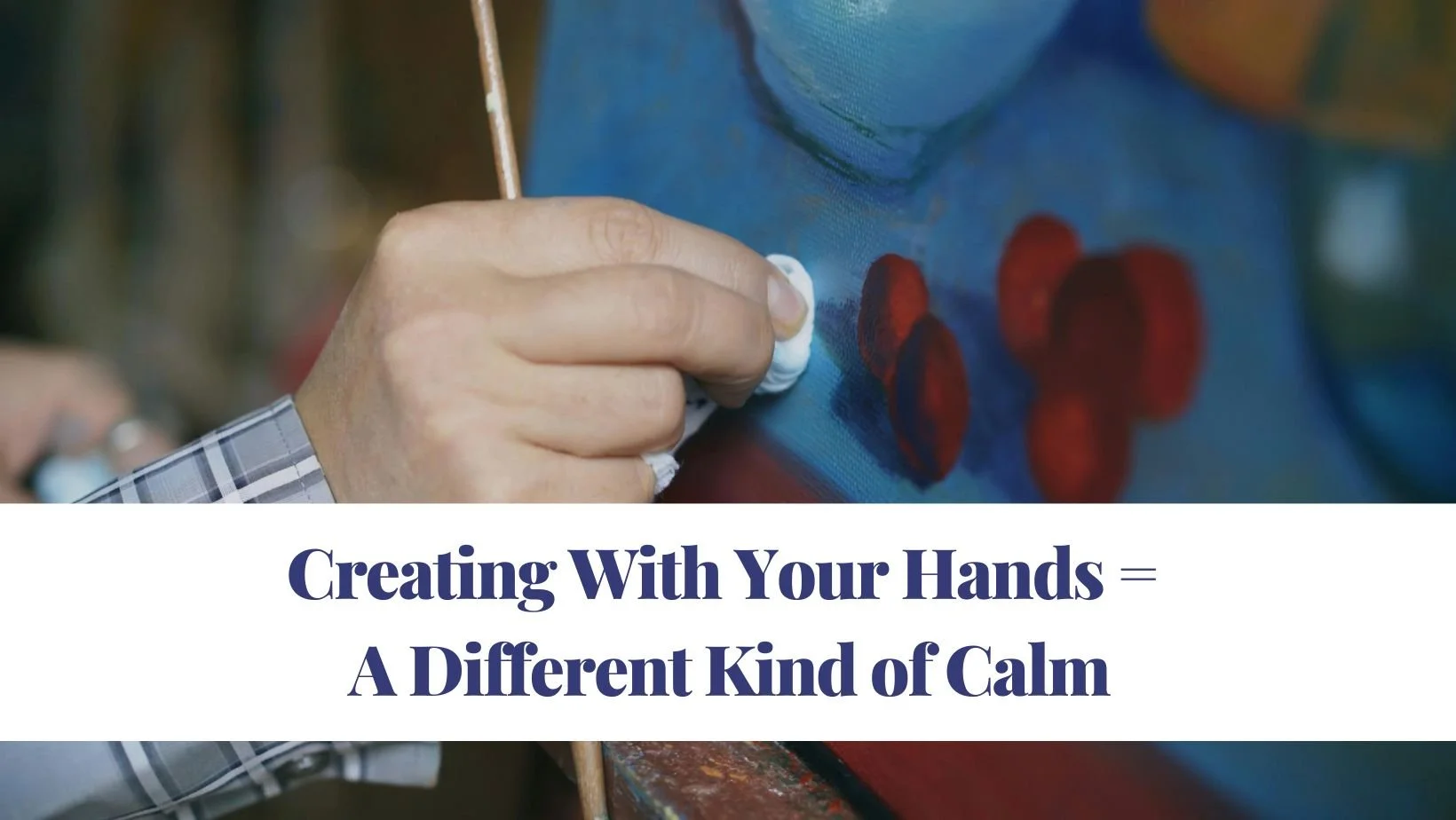
Creating With Your Hands Offers a Different Kind of Calm
There is something grounding about making something with your hands.
Painting, drawing, mixing colors, gardening, baking, sewing, building, or working on any creative project asks you to be present in a way scrolling does not.
You cannot paint a brushstroke that already happened or one that might happen ten minutes from now.
You can only work with the brushstroke in front of you.
You look.
You make a decision.
You place the brush on the canvas.
Then you look again.
That rhythm naturally brings your attention into the present moment.
When you are painting, you are not trying to absorb ten different pieces of information at once. You are focusing on a shape, a color, a line, or one small section of the image.
You are working step by step.
Your thoughts may still wander, but the painting keeps inviting you back.
Back to the color you are mixing.
Back to the movement of the brush.
Back to what your hands are doing.
It is a quieter form of attention.
And for many people, it becomes a much more satisfying way to unwind.
Painting a Pet Makes the Experience Even More Meaningful
Creating something connected to an animal you love adds another layer to the experience.
A pet portrait is not just a painting exercise.
It is personal.
You know that face.
You know the expression they make when they want something. You know the way they sit, the tilt of their head, the shape of their ears, and the tiny details that make them completely themselves.
Maybe your pet is curled up beside you while you paint.
Maybe they are following you around the room, wondering why you keep looking from the photograph to the canvas.
Or maybe you are painting a pet you have lost and creating something that helps you honor the life you shared.
Either way, the subject matters to you.
That emotional connection helps pull you out of the constant stream of outside information and into something that belongs to your own life.
You are not creating because an algorithm placed something in front of you.
You are creating because you love this animal.
You are spending time looking closely at their face, remembering their personality, and turning that connection into something tangible.
That kind of attention feels very different from scrolling past hundreds of images you may never remember.
Creativity Is Not About Getting Everything Right
One of the biggest things I have noticed in more than 15 years of teaching is how often people arrive believing they need to get everything right.
They want to know the correct color.
The correct brush.
The correct amount of paint.
The correct place to start.
They are afraid that one mistake will ruin the entire painting.
But art does not really work that way.
Painting is a process of adjusting.
You add a layer.
You step back.
You notice what is working and what needs to change.
You lighten an area.
You darken another.
You cover something, reshape it, soften it, or try a different approach.
You respond to what is actually on the canvas rather than fighting for the perfect image you imagined at the beginning.
And honestly, that is not so different from life.
We rarely have ideal conditions.
We make decisions with the information, energy, resources, and circumstances available to us.
Then we adjust.
We learn.
We work with what is in front of us.
Painting gives us a low-pressure place to practice that.
A line can be changed.
A color can be mixed again.
A section can be painted over.
You learn that an imperfect step does not mean the entire project has failed.
It simply means you keep going.
Creating Feeds Your Mind Differently Than Consuming
There is a major difference between watching someone else make something and making something yourself.
Watching can be enjoyable and inspiring.
But creating asks more of you.
You make decisions in real time.
You solve small problems.
You coordinate what your eyes see with what your hands are doing.
You experiment.
You learn what happens when you use more water, less paint, a smaller brush, or a different kind of pressure.
You are not passively receiving information.
You are participating.
And that participation creates a different kind of satisfaction.
There is often a moment near the end of a class when a student steps back, looks at the painting, and says something like:
“Wait. I actually made this?”
That moment never gets old.
It is not only pride in the finished painting.
It is the realization that they were capable of doing something they had already decided might be beyond them.
They did not just watch someone else be creative.
They experienced their own creativity.
Real Rest Is Not Always Passive
We often assume that relaxing means doing as little as possible.
We collapse on the couch, turn on a show, and scroll on another screen at the same time.
Our bodies may be still, but our minds are still processing a constant stream of information.
True rest can sometimes come from focused simplicity instead.
One activity.
One project.
One thing asking for your attention.
Creative work gives your mind somewhere gentle to land.
You are not trying to be productive in the usual sense.
You are not answering emails, making plans, or completing a task for someone else.
You are simply making something.
That can interrupt overthinking, comparison, and the feeling that your attention belongs to everyone and everything except you.
For a little while, you return to your own pace.

You Do Not Need to Be an Artist
Many adults avoid creative activities because they believe the result has to be impressive.
They say things like:
“I cannot draw.”
“I am not artistic.”
“I would mess it up.”
But creativity is not reserved for people who already feel confident.
You do not need to identify as an artist to benefit from making art.
You do not need to show anyone what you create.
You do not need to post it online.
You do not need to turn it into a business, a side hustle, or something productive.
You are allowed to create simply because the process feels good.
You are allowed to be curious.
You are allowed to be a beginner.
You are allowed to make something imperfect and still enjoy the experience.
In fact, sometimes keeping the experience private makes it even more meaningful.
It becomes something you did for yourself rather than something you created for approval.
A Creative Reset in Sedona
If you live in Sedona or are planning a visit, an in-person painting workshop can be a wonderful way to build tech-free time into your day.
My Sedona painting workshops at Lovejoy Creations are designed specifically for beginners and first-time painters.
You do not need to arrive knowing how to draw or paint.
I guide you through the process step by step, help you when you get stuck, and create a relaxed environment where you can focus on the experience without feeling pressured or judged.
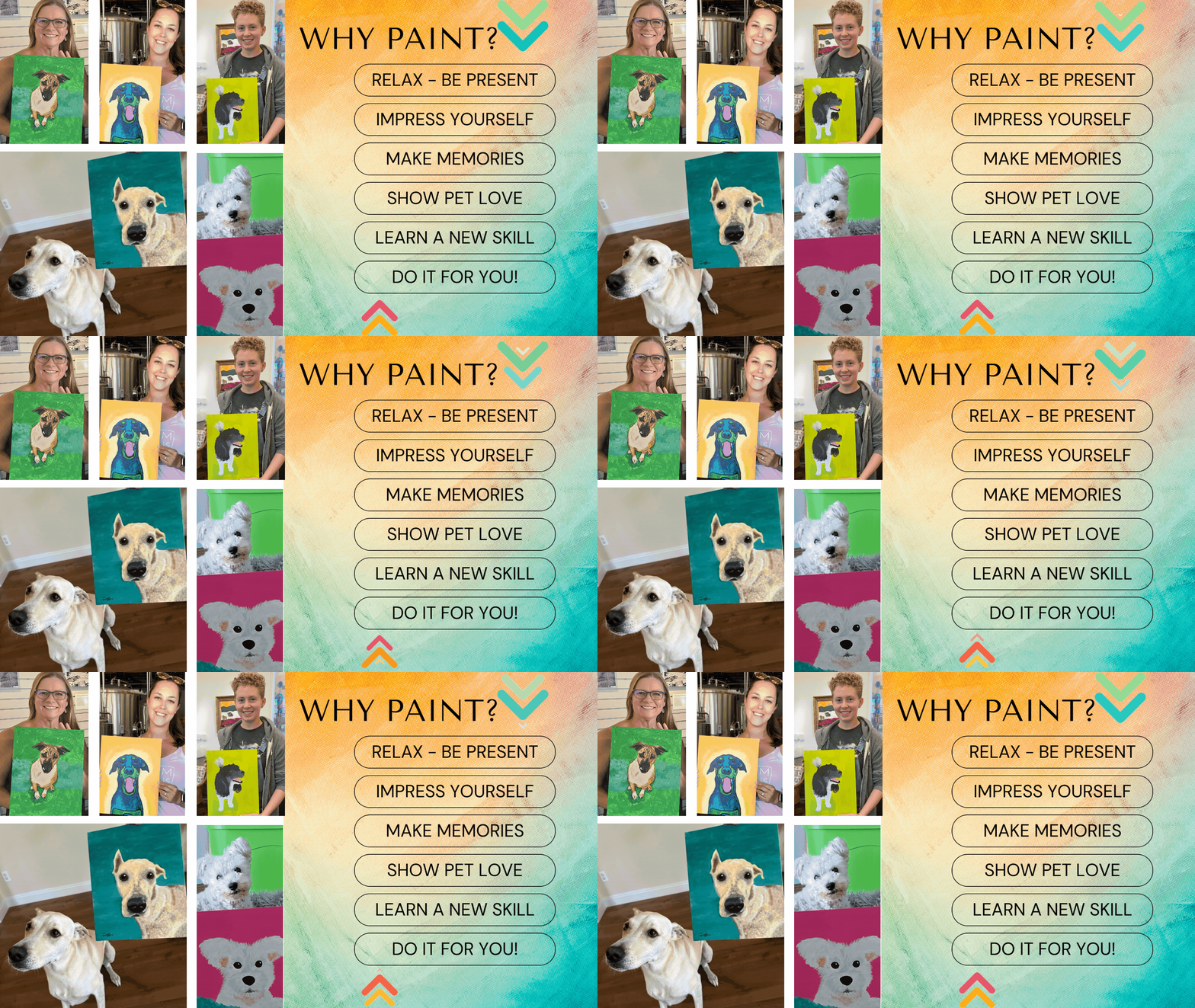
You can paint a pet you love or choose one of my beginner-friendly Pick Your Painting projects.
The goal is not to rush through the class or make everyone’s painting look exactly the same.
The goal is to give you a few hours to slow down, use your hands, learn something new, and leave with something personal that you created.
It is a different kind of Sedona experience.
Not another place to hurry through for a photograph.
Not another activity where your phone needs to be part of every moment.
Just time to sit, paint, and be where you are.
See upcoming Sedona painting workshops and reserve your spot.
San Diego Workshops
I also return to San Diego several times each year to teach in-person workshops.
These classes have the same beginner-friendly structure and step-by-step guidance as my Sedona workshops.
They are a chance to step away from your usual routine, spend time creating, and paint something meaningful in a supportive environment.
Many of my San Diego students return again and again—not because they suddenly decided they needed to become professional artists, but because they enjoy how the process makes them feel.
They enjoy having a few hours where their attention is focused, their hands are busy, and they are creating something that matters to them.
View upcoming Paint with Lovejoy workshops in San Diego.
Creating at Home
You can also create this kind of experience at home.
Maybe your version of a creative reset is comfortable clothes, your favorite drink, your pet nearby, and an afternoon with nowhere else to be.
My self-paced Paint Your Pet online course guides you through the process step by step so you can work at your own pace.
You can pause when you need to.
Repeat a section.
Take a break.
Return the next day.
There is no need to keep up with anyone else.
You can also find free painting tutorials and creative inspiration through Paint with Lovejoy.
The important part is not where you create.
It is giving yourself permission to begin.
Start Smaller Than You Think
You do not need to remove every app from your phone.
You do not need to spend an entire weekend offline.
You do not need to create the perfect studio, buy every art supply, or wait until you have a completely free day.
Start smaller.
Put your phone in another room for an hour.
Choose one simple project.
Clear a small space at the table.
Use the supplies you already have.
Let the experience be imperfect.
You may be surprised by how long an hour feels when you are no longer dividing your attention between a project and a screen.
And you may be surprised by how much fuller that hour feels when you have something tangible to show for it.
Not because the painting needs to be perfect.
But because you were present for it.
A Final Thought
We are surrounded by more content than we could ever possibly consume. There will always be another video, another post, another headline, another notification, and another person asking for our attention. But more content is not always what we need. Sometimes we need more moments that feel like our own. More curiosity.More connection.More creativity.More time doing something simply because it feels meaningful.Less consuming.More creating.Less comparison.More presence.Less noise.More of yourself. And sometimes the path back to that is incredibly simple. Put down the phone. Pick up a paintbrush. And see what happens.
Explore your next creative experience:
Join a beginner-friendly painting workshop in Sedona.
See upcoming San Diego painting classes.