🎨 Why It’s So Hard to Try Something You Might Not Be Good At
There is a quiet moment that happens before almost anything new. You feel a spark of curiosity, maybe even a little excitement, and for a brief moment you can imagine yourself doing the thing. You picture taking the class, starting the project, learning the skill, or finally trying something you have thought about for a long time. Then, almost as quickly as the interest appears, another thought slips in: What if I’m not good at it?
The thought is rarely dramatic enough to feel like fear. It usually sounds practical. Maybe you decide you do not have enough time right now, or that you should wait until life settles down. Maybe you tell yourself you are not naturally artistic, coordinated, musical, athletic, or creative enough. You do not consciously reject the idea. You simply stop moving toward it.
That hesitation is incredibly common, especially in adulthood. We often assume we are afraid of failure, but the reality is usually more complicated. What we are often reacting to is the vulnerability of being inexperienced. Trying something new means temporarily stepping into a place where we do not know exactly what we are doing, and for adults who have spent years becoming competent in the routines of everyday life, that can feel surprisingly uncomfortable.
Most of us move through our days with a tremendous amount of learned confidence. We know how to drive, prepare meals, answer messages, manage work, handle responsibilities, navigate familiar social situations, and solve the kinds of problems we have solved many times before. We rarely stop to think about how much knowledge sits underneath all of those ordinary actions because that knowledge has become automatic.
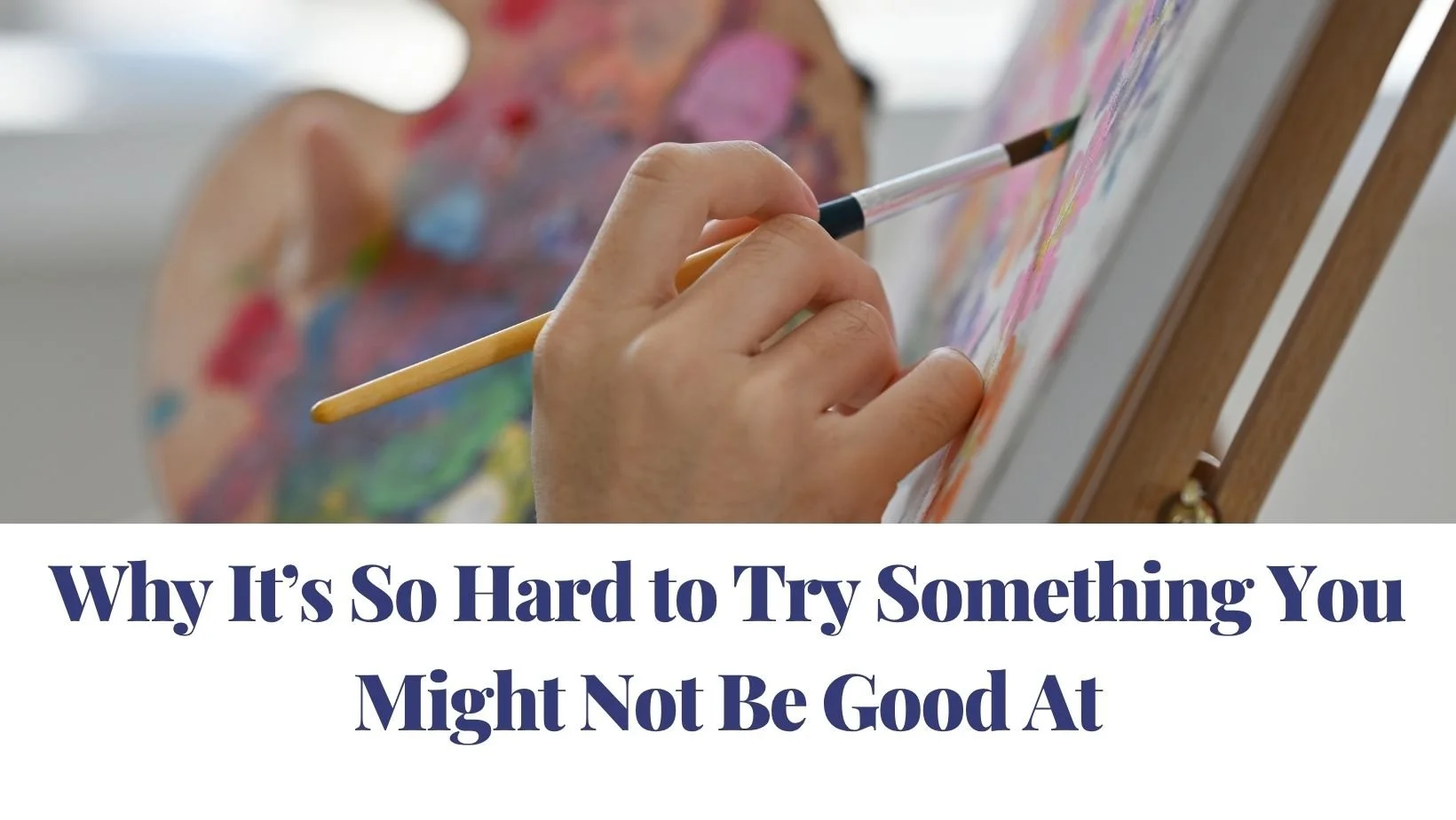
Then we sit down in front of a blank canvas and suddenly there is no automatic answer. Which brush should I use? How much paint do I need? Where do I begin? What happens if I make a mistake? Why does the color on the canvas look different from the color I imagined?
For a moment, we are beginners again.
That position can feel strangely exposed because being a beginner requires us to surrender certainty. We do not yet know what the finished result will look like. We do not know whether our hands will cooperate with what we see in our minds. We may need instructions. We may need to ask questions. We may make choices that we later change. None of these things are dangerous, but they are unfamiliar, and unfamiliarity has a way of making the brain cautious.
Our brains are remarkably good at steering us toward what is predictable. When we enter a situation with an uncertain outcome, part of the mind begins quietly evaluating risk. Could I embarrass myself? Could I waste my time? Could I discover that I am not naturally good at this? Could everyone else seem more capable than I am?
Those questions can turn into thoughts that sound entirely reasonable. Maybe this just isn’t my thing. I should probably wait. I do not have enough time right now. I am not creative anyway. Because the thoughts sound logical, we often accept them without noticing that they may simply be discomfort dressed up as a conclusion.
Children tend to approach new experiences very differently. A child will draw a purple horse, build a crooked tower, sing a song without knowing every word, or invent a game without worrying whether anyone would consider them talented. The activity itself is enough. Curiosity carries them forward.
Somewhere along the way, many adults stop thinking like that. We begin attaching identity to ability. Instead of saying, “I have never learned how to paint,” we say, “I am not artistic.” Instead of saying, “I have never taken a dance class,” we say, “I cannot dance.” Instead of recognizing that a skill has not been developed yet, we turn inexperience into evidence about who we are.
That is a much larger conclusion than the situation deserves.
Painting is a particularly interesting example because so many people approach it as if artistic ability should somehow appear before artistic experience. People often tell me they would love to paint, but they are not good at it. Yet if they have never really painted, there has never been a fair opportunity to find out what they could learn.
It is a little like deciding you are bad at playing the piano before anyone has shown you where the notes are.
Perfectionism often sits quietly underneath this hesitation as well. We tend to imagine perfectionism as someone obsessing over tiny details or endlessly adjusting something that is already finished, but perfectionism can appear much earlier in the process. Sometimes perfectionism is refusing to begin unless there is a reasonable chance we will be good.
It can sound like wanting the painting to look right the first time, not wanting to waste materials, worrying that the finished piece will look childish, or feeling as though everyone else in the room might naturally understand something that we do not. We want the confidence that comes from experience without having to go through the inexperienced part first.
Unfortunately, there is no way around being new.
Every artist whose work you admire once held a brush awkwardly. Every musician once played the wrong note. Every writer has stared at a blank page without knowing what should come next. Skill develops because people spend time moving through the stage where skill has not developed yet.
Beginners are not failed experts. They are simply people at the beginning.
What we usually fear, then, is not failure itself. We are often afraid of the feelings that might accompany it. We do not want to feel foolish, frustrated, awkward, disappointed, or uncertain. We do not want the thing we make to fall short of the image we had in our minds. We do not want to sit in the uncomfortable middle of a process without knowing whether it will eventually work.
But that uncomfortable middle is where learning actually happens.
Confusion does not mean you are incapable. A messy beginning does not mean the finished piece will be bad. Feeling awkward with a brush does not mean you are not artistic. These are simply signs that your brain and body are doing something they have not practiced before.
One of the most useful shifts I have found is to change the question entirely. Instead of asking, Am I going to be good at this? try asking, Am I willing to experience this?
The first question turns the activity into a test. There is immediately a possibility of passing or failing, being talented or untalented, producing something worthy or disappointing. The second question creates much more room. You do not need to prove anything. You only need to participate long enough to find out what the experience is actually like.
That shift matters because trying something new becomes much easier when the goal is curiosity instead of performance.
This is also why structure can make such a difference for beginners. A blank canvas can feel overwhelming when there are a hundred possible decisions and no obvious first move. When the process is broken into clear steps, the mental load becomes much smaller. You do not have to understand the entire painting at once. You only need to know what comes next.
That is a large part of how I approach my beginner-friendly painting workshops in Sedona. People are not expected to arrive already knowing how to paint. The class exists precisely because they do not know yet. The process is structured so that people can learn while they are doing rather than feeling as though they should somehow prepare themselves to be creative before they arrive.
If taking a class in person feels like too large a first step, you can also begin privately at home with my Acrylic Painting Crash Course. It teaches the basic tools, materials, brush techniques, color mixing, and foundational skills that make acrylic painting feel far less mysterious. Sometimes learning a few fundamentals in your own space is exactly what you need to make the next creative step feel possible.
Once people begin painting, I often watch something shift.
At first, they may be cautious. They watch the brush closely. They look around the room to see what everyone else is doing. They apologize for things that are not mistakes. They tell me that their painting does not look right yet.
Then they add another layer, and another.
The painting begins to develop, but something else develops at the same time. Their body relaxes. Their decisions become quicker. They stop asking whether every mark is correct. They begin responding to what is actually happening on the canvas.
At some point, the person who walked in saying, “I am not artistic,” starts painting without thinking very much about whether they are artistic at all.
That moment is one of my favorite parts of teaching.
Often, somewhere near the end of the process, a student leans back and really looks at what they have made. There is usually a tiny pause before their expression changes. They recognize something in the painting that they were not sure they would be able to create.
What matters in that moment is not that they have suddenly become a professional artist. What matters is that they have collected a new piece of evidence about themselves.
They tried something they did not know how to do. They tolerated uncertainty. They kept going through the stage when the painting did not yet make sense. They made decisions, corrected things, adjusted colors, and found their way forward.
And now they know they can do that.
We often imagine confidence as something we need to possess before trying something difficult, but confidence usually works in the opposite direction. It grows after we act. We try something, survive being uncertain, learn a little, and try again. Eventually the unfamiliar becomes familiar enough that the brain no longer treats it as such a large threat.
That is how confidence is built. Not by convincing ourselves that we will be brilliant, but by gathering evidence that we can handle not knowing.
That lesson reaches far beyond painting.
Every time we willingly become a beginner, we practice entering unfamiliar territory. We discover that frustration passes, that mistakes can be adjusted, and that confusion often becomes clarity if we stay with something long enough. We learn that our abilities are not fixed at the moment we begin.
Perhaps even more importantly, we remember that we are allowed to do things we are not particularly good at.
Adults sometimes carry a strange expectation that hobbies must justify themselves. We think we should improve quickly, make something impressive, share the result, turn the activity into a side business, or at least become skilled enough for the time to feel worthwhile.
But creativity does not need to earn its place in your life.
You can paint because mixing colors feels satisfying. You can sing badly because singing makes you happy. You can learn pottery and make a lopsided bowl. You can grow imperfect vegetables. You can write stories nobody ever reads. You can make things simply because there is something deeply human about using your hands, your imagination, and your attention to create something that did not exist before.
Sometimes the experience itself is enough.
There will always be reasons to stay inside the boundaries of what you already know. Familiar things are efficient. They are predictable. They allow us to feel competent. But if we build our lives entirely around avoiding situations where we might temporarily feel awkward, we also eliminate a great deal of discovery.
Trying something new may lead to a skill you love, but it does not have to. Maybe you discover that painting becomes part of your life. Maybe you simply spend one peaceful afternoon doing something different. Maybe you create something you are proud to hang in your home. Maybe you meet someone interesting. Maybe you find that concentrating on color and shape quiets your mind in a way you did not expect.
Or maybe you try it once and decide it is not for you.
That is still valuable. You learned something real instead of letting fear make the decision for you.
If you are visiting Sedona and want even more ideas for stepping outside your usual routine, I put together a guide to the Sedona Artist Experience and creative things to try for beginners, hobbyists, and professional artists. There are many ways to experience this place beyond simply looking at it. Sometimes making something while you are here becomes part of how you remember the trip.
So the next time you catch yourself thinking, What if I’m not good at it? you do not have to argue with the thought or force yourself into false confidence. You can simply make the question a little larger.
What if being good at it is not the point?
What if the point is curiosity, participation, discovery, or giving yourself permission to be new at something again?
And with that, I invite you to step outside your comfort zone and simply try.
Try a painting class with me, or take a painting class with another instructor whose work inspires you. Sign up for that class you keep thinking about. Pick up the instrument you have always wanted to learn. Go somewhere new. Learn a skill that has absolutely nothing to do with your job. Take the adventure you have been postponing because some part of you thinks you should know what you are doing before you begin.
You do not have to leap dramatically into an entirely different life. You only have to take one step in the direction of something unfamiliar.
Growth so often lives just outside the borders of what is comfortable. Each time you cross that border, even by a few inches, your world becomes a little bigger. You learn something about the activity, but you also learn something about yourself. You discover another place you can go, another thing you can try, another version of yourself you did not know existed yet.
The first step may feel awkward. It may be imperfect. You may not be good at it.
Take it anyway.
Because the wonderful thing about stepping outside your comfort zone is that, once you have stood there for a while, it is no longer quite so far outside.
Your world has expanded to meet you.