The Creative Wound: How Early Experiences Shape What You Believe You Can Do
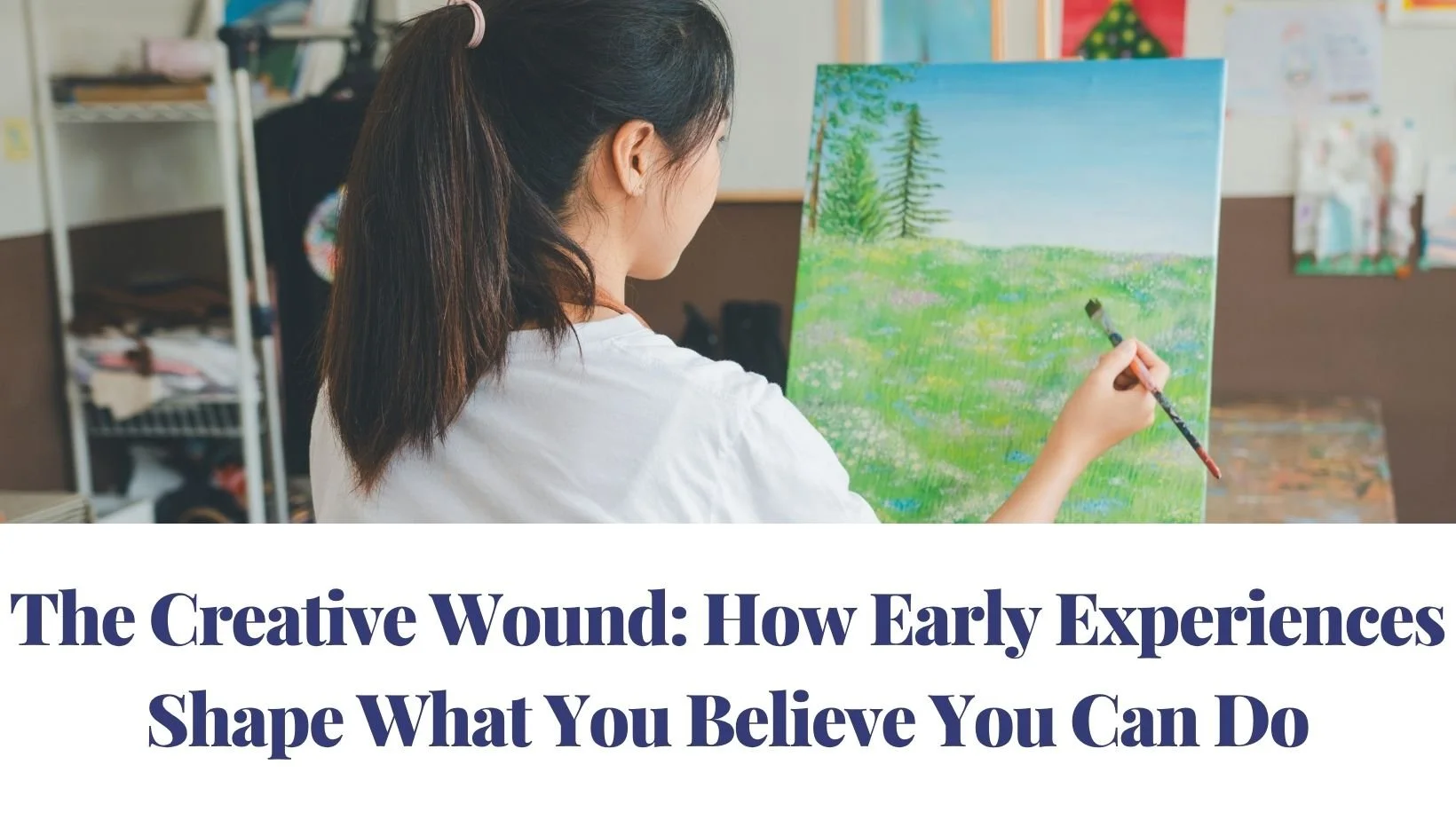
There are people who can walk into a painting class, sit down in front of a blank canvas, and announce almost immediately that they are not creative. They have not picked up a brush, mixed a color, or made a single mark, yet the conclusion already feels settled. Somewhere along the way, they learned to describe themselves as someone who cannot draw, cannot paint, or simply does not possess whatever mysterious quality separates creative people from everyone else.
What is striking is how rarely that belief gets examined. People repeat it casually, almost as though they are describing an objective characteristic about themselves. They say they are not artistic in the same matter-of-fact way they might say they are not tall or do not have blue eyes. The statement feels like self-knowledge, even when the evidence supporting it may consist of little more than a handful of experiences from childhood.
For many adults, the belief that they are not creative began with an experience that appeared insignificant from the outside. A teacher criticized a drawing. A classmate laughed at something they made. A parent compared their work with another child’s. They tried to sing and someone told them to stop. They wrote a story and the adult reading it noticed the spelling mistakes before noticing the imagination behind it. They colored something the “wrong” color and were corrected rather than asked why they had chosen it.
None of these moments had to be particularly dramatic to become influential. They only had to happen at a time when a child was still learning what kind of person they were. A disappointing experience could become evidence that art was not for them, and a temporary lack of skill could slowly become something much larger. Instead of thinking, “I have not learned how to do this yet,” the child began thinking, “I am bad at this.” With enough repetition, that conclusion could eventually become, “I am not creative.”
The shift is subtle, but its consequences can last for decades. A judgment about one drawing becomes a judgment about artistic ability, and a judgment about artistic ability becomes a judgment about identity. Once creativity has been placed outside the boundaries of who you believe yourself to be, you may stop looking for evidence that contradicts the conclusion.
How an Early Experience Becomes an Identity
Childhood is filled with conclusions formed long before there is enough evidence to justify them. Children are constantly learning about themselves through the responses of the people around them because they do not yet have the experience or perspective to evaluate every situation independently. Teachers, parents, siblings, classmates, coaches, and other significant people become mirrors through which children begin constructing an understanding of who they are.
A child who struggles with a drawing rarely has the perspective to recognize that drawing is a learned skill involving observation, hand-eye coordination, repetition, practice, and instruction. They do not think about the thousands of marks made by the person whose work looks effortless. They simply compare what they created with what they hoped to create, notice the gap, and search for an explanation.
If the explanation they receive is that they lack talent, the difference between ability and identity can disappear remarkably quickly. The child does not conclude that they need more practice. They conclude that they are not good at art. If that message is repeated or accompanied by embarrassment, criticism, comparison, or dismissal, it can become particularly convincing.
This happens partly because social experiences carry enormous psychological weight when we are young. Children are deeply attentive to approval, belonging, and the reactions of people whose opinions matter to them. A disappointing grade may fade from memory, while the embarrassment attached to receiving it remains vivid. The exact picture may be forgotten, but the memory of everyone laughing can remain. The adult may no longer remember what the teacher said, yet the emotional conclusion survives as a feeling that art is uncomfortable, exposing, or simply not for them.
The difficulty is that emotional intensity and objective truth are not the same thing. A teacher's criticism may have been real, but it was not a scientific measurement of a child’s creative capacity. A classmate laughing at a picture did not establish the limits of that child’s imagination. Being less skilled than someone else at eight years old did not determine what could be learned at thirty-eight, fifty-eight, or seventy-eight.
Nevertheless, once an experience has been translated into identity, the belief can begin reinforcing itself. A person who believes they are not artistic avoids drawing. Because they avoid drawing, they never develop the skill. Because the skill never develops, the original conclusion appears to have been correct. What began as a limited childhood experience gradually becomes a self-perpetuating adult story.
Why Avoidance Keeps the Old Story Alive
Avoidance has an interesting psychological effect because it can make an untested belief feel increasingly true. If an experience once caused embarrassment or disappointment, avoiding similar situations protects you from feeling that discomfort again. From that perspective, deciding that art simply is not your thing can feel entirely reasonable.
The immediate reward is relief. You no longer have to risk being bad at drawing because you do not draw. You do not have to discover whether you can sing because you never sing where anyone can hear you. You do not need to confront the awkwardness of learning pottery, photography, music, or painting because you have already placed those activities outside your identity.
The long-term cost is less obvious. Avoidance prevents new evidence from entering the picture.
If you never draw again, you never discover what better instruction might have changed. If you never try another creative medium, you never find out whether the original difficulty was specific to one activity rather than creativity itself. If you never allow yourself to become a beginner again, you never discover what patience, maturity, practice, or a more supportive environment might reveal.
Over time, the line between genuine preference and protective avoidance can become surprisingly difficult to see. Someone may sincerely believe that painting does not interest them when what actually feels intolerable is the possibility of being inexperienced. Someone may say they cannot dance when their deeper concern is being watched while learning. Someone may insist that they are not musical because they once struggled with an instrument and interpreted the struggle as evidence that they lacked ability.
This is one of the quieter consequences of a negative early creative experience. It does not simply affect the way someone feels about one painting, one instrument, or one classroom. It can gradually reduce the number of experiences they are willing to enter at all.
The Courage of Becoming a Beginner Again
When an adult eventually returns to creativity, the action may look remarkably ordinary from the outside. They register for a workshop, buy a sketchbook, sign up for pottery, or sit down in front of a canvas. Yet internally, they may be returning to territory they abandoned years earlier because it once made them feel incapable.
That is why trying again requires a particular kind of courage. The courage is not in knowing that the experience will go well. It is in allowing yourself to begin without requiring that guarantee.
Adults can find this especially difficult because much of adult life is organized around competence. We spend our days performing tasks we already understand, moving through routines we have repeated many times, and relying on skills that have become familiar enough that we rarely remember what it felt like to learn them. Returning to beginner status removes that protection. Suddenly, mistakes become visible again.
Creativity can make that vulnerability especially obvious because the evidence sits directly in front of you. The drawing does not look the way you intended. The first chords on the guitar sound awkward. The pottery leans. The first paragraph does not quite work. The painting passes through a stage where nothing seems to be coming together.
At that moment, an old belief can become very loud. If you have spent years believing that you are not creative, the normal difficulty of learning can feel like confirmation. The temptation is to interpret the awkward beginning as a verdict rather than a stage.
Trying again requires resisting that interpretation long enough for the experience to develop.
You do not need to replace the belief that you are uncreative with the equally pressurized belief that you must secretly be brilliant. The more useful position is curiosity. Perhaps the old conclusion was incomplete. Perhaps you were not incapable but inexperienced. Perhaps the instruction was poor. Perhaps the environment made you self-conscious. Perhaps the medium was wrong for you. Perhaps you simply needed more time than you were given.
The purpose of trying again is not to prove anything about yourself before you begin. It is to create enough room for new evidence to appear.
The Corrective Creative Experience
Psychology sometimes describes a corrective emotional experience as an encounter that contradicts an older emotional expectation strongly enough to create new information. Someone enters a situation expecting the familiar outcome, but something different happens. The past is not erased, yet it is no longer the only experience available for the mind to reference.
Creativity can offer exactly this kind of correction.
A person enters a painting class expecting to feel embarrassed and instead becomes absorbed in the process. They expect everyone else to be more talented and discover that the room is full of people learning at different speeds. They expect criticism and receive patient instruction. They expect frustration and discover concentration. They expect the painting to confirm their lack of ability, yet somewhere during the process they notice a section they genuinely like.
None of this requires the finished painting to be extraordinary. The deeper correction occurs because the experience itself does not unfold the way the person predicted.
Someone who expected failure discovers that they can learn. Someone who expected judgment discovers that creativity can happen in an environment that is patient and supportive. Someone who interpreted uncertainty as proof of inadequacy begins to understand that uncertainty is simply part of making something that does not yet exist.
The change may be surprisingly quiet. It might happen when someone steps back from the canvas and realizes that the image looks better than they expected. It might occur when they solve a problem they assumed they would need someone else to fix. It might happen when they realize that several hours have passed without their thinking about whether they are good enough because they became absorbed in the act of making.
These moments matter because they introduce contradiction into a story that once seemed complete. The old belief may still exist, but it now has to coexist with evidence that does not fit neatly inside it.
That is how identity begins to become more flexible. It is not necessarily replaced by a dramatic new declaration. It simply becomes harder to say, with the same certainty, that creativity is something you do not possess.
Why Painting Can Be an Especially Powerful Place to Begin
Painting is particularly useful for this kind of corrective experience because the process becomes visible in front of you. You begin with an empty surface and gradually change it through a series of decisions. You choose a color, adjust a shape, soften an edge, darken an area, cover something you dislike, and try again.
By the end, something exists that did not exist before you sat down.
That fact can be surprisingly powerful for someone who has spent years believing they are not creative. Even in a guided class where everyone begins with the same reference, no two paintings emerge exactly alike. Brush pressure differs. Color choices shift. Shapes vary. One person emphasizes details another person barely notices. Individual decisions accumulate until the finished piece carries evidence of the person who made it.
Painting also reveals something fundamental about the creative process that beginners rarely understand before experiencing it. Most paintings pass through an awkward middle. There is a stage when the shapes are only partially developed, the colors have not yet begun working together, the proportions still need adjustment, and the final details that give the image coherence have not been added.
To someone who already doubts their ability, that unfinished stage can look like failure.
The corrective part of the experience often comes from continuing anyway. Another layer changes the depth. An adjustment improves the proportion. A new color brings two sections together. One problem gets solved, then another, and something that seemed disjointed begins to become coherent.
The lesson extends far beyond the mechanics of painting. You begin to understand that an unfinished process cannot fairly be judged as though it were a finished result. You learn that discomfort does not automatically mean failure and that confusion can be part of learning rather than evidence that you should stop. You experience, in a tangible way, how persistence can change something that initially looked hopeless.
When the painting is finished, the most important realization may not be that you created something beautiful. It may be that your first interpretation of the process was wrong. You thought the awkward stage meant you could not paint, but it turned out to mean that the painting was not finished yet.
That distinction is small enough to overlook and important enough to change the way you approach many other things.
Creativity Has Probably Been There All Along
One of the reasons people underestimate their own creativity is that our cultural definition of art is remarkably narrow. We tend to reserve the word creative for painters, writers, musicians, dancers, actors, and other people whose work fits comfortably within traditional artistic categories. Anyone who does not participate in those forms may conclude that creativity simply does not apply to them.
Yet creativity appears constantly in ordinary life.
A gardener makes decisions about color, texture, spacing, proportion, season, movement, and scale. A cook works with flavor, timing, presentation, memory, substitution, and experimentation. Someone decorating a home considers light, visual balance, atmosphere, comfort, color, and the relationship between objects within a space. Someone arranging flowers responds to line, contrast, shape, negative space, and movement even if they have never used those words to describe what they are doing.
The same underlying capacity appears in countless other forms. It is present when someone modifies a recipe because an ingredient is missing, rearranges a room until it finally feels right, chooses clothing that expresses something about who they are, photographs a sunset, restores an old piece of furniture, decorates a cake, sews a garment, builds something from wood, designs a garden bed, or creates a thoughtful gift for someone they love.
Writing, storytelling, photography, cooking, gardening, woodworking, interior design, fashion, ceramics, embroidery, collage, music, dance, floral design, and filmmaking are all obviously creative when we allow ourselves to look at them that way. Creativity also extends into places that are rarely labeled artistic. Planning an event, designing an efficient system, developing a lesson, reorganizing a difficult space, solving an unusual business problem, or finding a new solution to an everyday frustration all require some ability to imagine an outcome that does not yet exist and make choices that bring it closer to reality.
Creativity, then, is not merely the ability to make a convincing painting. It is a way of interacting with possibility.
Seen from that perspective, many people who insist that they are not creative have actually spent their entire lives creating. They simply learned to discount the forms of creativity that came naturally to them because those forms did not resemble the narrow image of an artist they were taught to recognize.
A corrective creative experience can therefore involve more than discovering a new ability. It can also involve recognizing an ability that was already there.
What Changes When Creativity Becomes Available Again
Once creativity stops belonging exclusively to other people, the boundaries of what feels possible begin to move. The change may start with a painting, but it rarely needs to end there.
The significance lies in the shift from exclusion to participation. A pottery class that once seemed designed for artistic people begins to look like something you could try. A watercolor set stops feeling like equipment you would not know how to use and starts looking like an invitation to experiment. Writing becomes something you can explore without first deciding whether you have a book inside you. Music can become an activity worth learning even if no one will ever hear you perform.
This shift matters because adulthood often makes exploration conditional. Children are routinely allowed to try things simply because they are curious. Adults tend to demand more justification. We ask whether an activity will be useful, whether we will be good at it, whether the result will be worth the time, or whether the skill can eventually become productive.
Creativity offers a very different relationship with experience because it reminds us that participation does not always need to earn its place through achievement.
A painting does not have to become a product. A photograph does not have to be posted. A story does not need to become a book. A garden does not need to impress anyone. A hobby does not need to become a business, and an interest does not have to develop into expertise before the time spent pursuing it becomes worthwhile.
For someone whose earliest creative experiences were dominated by judgment, this can represent a profound change. The central question is no longer whether the result proves that you are talented. The question becomes whether the experience itself is interesting, meaningful, challenging, absorbing, or enjoyable.
That shift allows curiosity to occupy the space once held by evaluation.
A New Experience Changes the Meaning of Uncertainty
The influence of a corrective creative experience extends beyond the class itself because it gives you a new memory of what it feels like to be uncertain.
Before that experience, not knowing what to do may have felt like evidence that you were incapable. Struggling may have seemed like proof that you did not belong. The discomfort of being a beginner could be interpreted as a signal that you should stop before you exposed your limitations.
After moving through an entire creative process, uncertainty becomes harder to interpret so simply.
You remember the blank canvas and the moment when you had no idea how the finished painting would emerge from it. You remember the awkward middle and the temptation to judge the work too early. You also remember that the painting changed because you continued. What looked unsuccessful at one stage became the foundation for what appeared later.
That experience introduces a distinction that is easy to understand intellectually and much harder to believe emotionally: being incapable of something and not knowing how to do it yet can feel almost identical at the beginning.
Both involve mistakes. Both involve hesitation. Both contain moments when progress is difficult to see. The difference usually becomes visible only after enough time has passed for learning to occur.
Once you have experienced that progression yourself, you become less willing to use the discomfort of the beginning as evidence about the outcome. You begin to understand that an awkward first attempt may tell you very little about what is possible with another hour, another class, another project, or another year of practice.
This does not mean that persistence guarantees mastery. Some activities will never interest you, and some skills may remain difficult regardless of effort. The deeper lesson is more measured. You learn that your capacity cannot always be determined from your first encounter with something unfamiliar.
That realization is useful far beyond creativity. When something new feels difficult, you now have another interpretation available besides failure. You have evidence that confusion can precede understanding and that incompetence at the beginning does not automatically reveal incapacity at the end.
The creative experience has changed your relationship with uncertainty.
Instead of seeing the unfamiliar only as a place where your limitations might be exposed, you can begin to recognize it as the place where abilities you have never tested might also be discovered.
When the Old Conclusion Begins to Lose Its Authority
There is something profoundly limiting about allowing a judgment formed in childhood to determine which parts of adulthood you are willing to explore. The original experience may have lasted only a few minutes, yet the conclusion drawn from it can shape decisions for decades.
A comment made in an elementary school classroom can quietly follow someone into middle age. A moment of embarrassment can become an invisible boundary around activities they never attempt again. A child may decide that art is not for them and spend the next forty years behaving as though an eight-year-old had been qualified to make that decision permanently.
The influence of those experiences should not be dismissed simply because they happened long ago. Childhood is precisely when many of our earliest beliefs about ourselves are formed, and the adults and peers around us have considerable power to influence them. A child who is repeatedly told that their imagination is impractical, their drawings are not good enough, or their creative interests matter less than other abilities may reasonably begin withdrawing from that part of themselves.
Adulthood does not give us the power to erase those experiences. It gives us something more useful: the ability to reconsider the conclusions we drew from them.
The child who decided they were not artistic could not know what they might enjoy twenty years later. They did not know what kind of teacher would suit them, which medium might feel natural, how much patience they would develop, or how different learning would feel once grades, comparison, and childhood approval were no longer part of the experience.
A new creative experience allows the adult to revisit a conclusion the child had no reason or ability to question.
Perhaps painting reveals an unexpected sensitivity to color. Perhaps pottery feels more intuitive because working with the hands is satisfying in a way drawing never was. Perhaps photography, writing, woodworking, gardening, sewing, cooking, music, or some other form becomes the creative language traditional art classes never provided.
The discovery does not need to be dramatic to matter. You may simply realize that you enjoy making things. You may notice that working with your hands changes the quality of your attention. You may find satisfaction in solving visual problems or watching an idea gradually become tangible. You may even discover that you are entirely average at something and still love doing it.
That possibility deserves more respect than adults usually give it.
We have a tendency to turn enjoyment into achievement. If we paint, we wonder whether the painting is good enough to display. If we write, we begin wondering whether the writing should be published. If people compliment something we make, we may immediately consider whether it could become a business.
What began as curiosity becomes another arena for evaluation.
A healthier relationship with creativity allows something to matter without becoming an accomplishment. Making can be worthwhile because it requires attention, experimentation, observation, decision-making, and engagement with something that is still becoming.
Sometimes the most important discovery is simply that there are parts of yourself you have not finished meeting.
As the old conclusion loses authority, the world does not suddenly become unrecognizable. It expands gradually. A class that once felt intimidating becomes possible. An art supply store becomes interesting rather than irrelevant. Something you once dismissed as being for other people becomes available for your consideration.
The change is larger than finding another hobby.
An entire category of experience you once excluded yourself from is no longer automatically closed.
Giving the Story a Different Ending
If you have spent much of your life believing that you are not creative, it may be worth becoming curious about where that belief began.
You may remember the classroom, the teacher, the parent, the comment, the laughter, or the project that made you decide you were not good enough. You may not remember any specific event at all. Sometimes the experiences themselves fade while the conclusion survives.
Whatever its origin, the belief deserves examination rather than automatic obedience. It may have been an understandable conclusion for a child with limited evidence and little control over the environment in which they were learning. That does not make it an accurate description of the adult that child eventually became.
Trying again does not require replacing one rigid identity with another. You do not need to walk into a painting class declaring yourself an artist, nor do you need to convince yourself that some hidden genius is waiting to be uncovered. That would simply create another standard against which the experience could be judged.
The more interesting possibility is to leave the question open.
Painting is one of the easiest ways to do that because it provides a visible creative process from beginning to end. The blank canvas gives you a clear starting point, while the finished painting becomes physical evidence that your choices, attention, and willingness to continue transformed something.
Yet the painting itself is not the most important evidence.
The more meaningful evidence is what happened while you were making it. You encountered uncertainty and continued. You made decisions without knowing exactly how they would turn out. You watched parts of the painting look awkward before they began working together. You adjusted rather than abandoning the entire process. Somewhere along the way, you stopped trying to prove whether you were creative and became occupied with the act of creating.
That experience can become a quiet contradiction to a belief you may have carried for decades.
The younger version of you made the best conclusion they could from the evidence available at the time. The adult version of you is allowed to gather more.
You may discover that the teacher was wrong, that the environment was wrong, that the medium was wrong, or that you simply had not been given enough time to learn. You may also discover that creativity had been present throughout your life in the gardens you designed, the meals you improvised, the photographs you took, the rooms you arranged, the stories you told, the clothes you combined, the problems you solved, and the countless ways you shaped the world around you without recognizing those actions as creative.
A corrective creative experience does not erase the earlier experience that shaped you, nor does it need to. The past can remain true without remaining authoritative. The child who felt embarrassed, discouraged, or incapable was responding to the world as they understood it then. What changes is that their conclusion is no longer the only evidence available.
Years from now, the particular painting that helped create that realization may matter very little. It may hang on a wall, disappear into a closet, or become one of dozens of things you eventually make. Its artistic quality may become almost irrelevant.
What may stay with you is the memory of walking into an experience convinced that you already knew what it would reveal about you and discovering that the story was more complicated.
Perhaps you were never as uncreative as you had been led to believe.
Perhaps you simply learned, much too early, to stop looking for that part of yourself.
A new creative experience gives you the opportunity to look again, this time with the perspective, autonomy, patience, and curiosity that you did not have the first time.
And sometimes that is enough to change much more than a painting.